
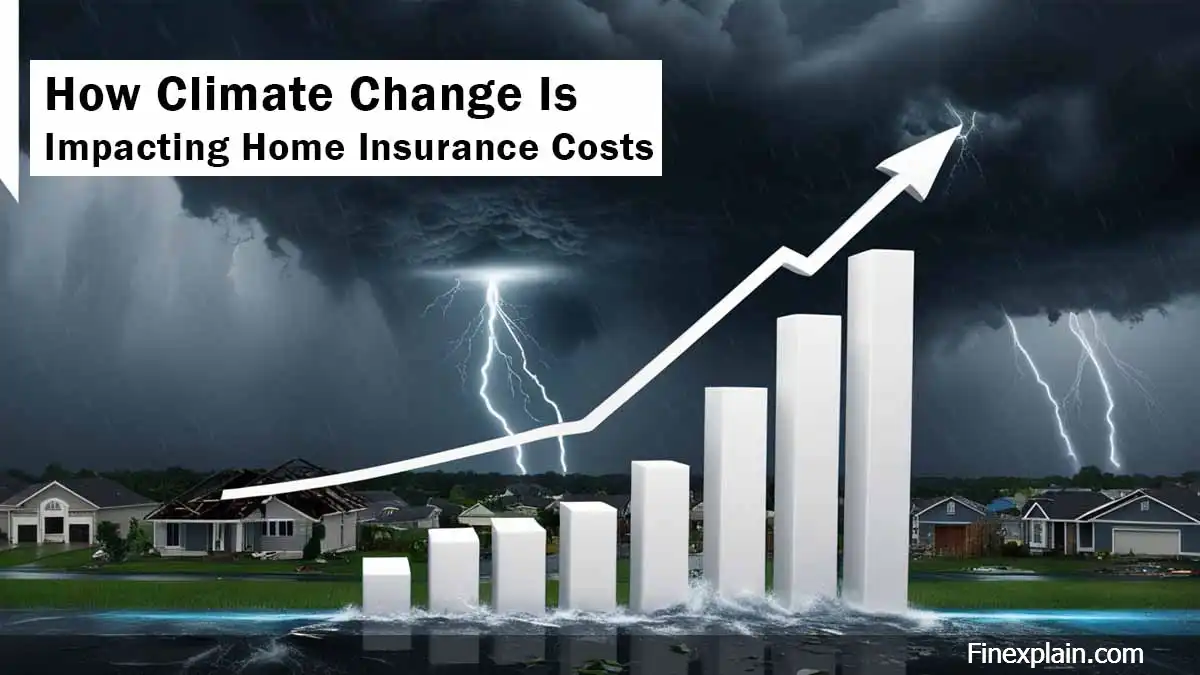
Your home insurance bill isn’t just rising — it’s racing ahead of inflation, wages, even your mortgage. Why? Because climate change is redrawing the map of risk: wildfires burn subdivisions, floods swallow inland neighborhoods, hurricanes stall over cities. Insurers aren’t guessing — they’re pricing a new reality.
Why Home Insurance Is Getting More Expensive: The Climate–Damage Connection
In the past two decades, the link between a warming planet and soaring insurance costs has gone from theory to ledger-book reality. Insurers don’t bet on weather — they bet on patterns. And those patterns have shifted dramatically. What used to be “once-in-a-generation” disasters now happen every few years — or even annually — in the same region. When storms hit harder, burn longer, and flood wider, someone has to pay for the cleanup. Increasingly, that “someone” is every policyholder.
Consider this: according to Munich Re, one of the world’s largest reinsurers, the U.S. saw over 100 weather- and climate-related billion-dollar disasters in the 2010s — more than double the number in the 1980s. And it’s not just frequency: each event is also getting costlier. A hurricane today doesn’t just knock down trees — it collapses entire neighborhoods built on coastlines once considered “safe.” A wildfire doesn’t just threaten forest cabins — it engulfs subdivisions with ember storms traveling miles ahead of the flame front.
This rising tide of loss is reflected in payouts. The chart above tracks inflation-adjusted insured losses from major natural catastrophes in the U.S. over the last 20 years. Notice the upward slope — and the increasingly frequent spikes. It’s not a straight line; it’s a staircase, with each step higher than the last.
But it’s not just how often disasters strike — it’s how much each one costs. Rebuilding a home today isn’t like it was 20 years ago. Labor and materials are pricier, building codes are stricter (and rightly so), and homes themselves are larger and more complex. When disaster strikes, the average claim has ballooned — especially for certain perils.
| Disaster Type | Avg. Loss per Event (2000–2004) | Avg. Loss per Event (2019–2023) | Increase |
|---|---|---|---|
| Hurricanes & Tropical Storms | $1.2B | $4.8B | +300% |
| Wildfires | $0.3B | $2.1B | +600% |
| Inland Flooding | $0.5B | $1.7B | +240% |
| Severe Thunderstorms (incl. hail, wind) | $0.8B | $2.9B | +263% |
Wildfires stand out: average losses have jumped sixfold. Why? Suburban sprawl into fire-prone “wildland–urban interface” zones, combined with drier fuels and longer fire seasons, means a single spark can now ignite tens of thousands of homes — not just a few. Insurers see this pattern and adjust premiums accordingly: not as punishment, but as a reflection of measurable, escalating risk.
In short: climate change isn’t a distant environmental concern — it’s already in your mailbox, stamped on your insurance renewal notice.
How Risk Maps — and Your Premiums — Are Being Redrawn
Just a decade ago, “high-risk” meant coastal Florida, wildfire-prone California hills, or tornado alley in the Plains. Today, the danger zones are expanding inward — and upward. Climate change isn’t just intensifying disasters; it’s redrawing the very boundaries of where they’re likely to strike. Sea-level rise pushes saltwater into neighborhoods miles from the shore. Drought turns once-green European valleys into fire corridors. And warmer oceans fuel storms that dump historic rainfall far from traditional hurricane paths.
Insurers and governments are updating their risk models in real time — and the new maps tell a sobering story. FEMA’s updated flood maps now place 5 million more U.S. properties in high-risk zones than just five years ago. In Europe, the European Environment Agency reports that areas with “high wildfire risk” have grown by 40% since 2000, reaching suburbs of Athens, Lisbon, and even parts of southern Germany. In Japan, revised typhoon surge models after 2019’s Hagibis expanded evacuation zones inland by up to 15 kilometers.
When the Map Changes, Your Bill Does Too
For homeowners, a map update can mean an instant — and steep — premium hike. In Florida’s Lee County, average home insurance premiums jumped 72% between 2020 and 2024 after Hurricane Ian rewrote the storm-surge models. In California’s Sonoma County, insurers began non-renewing policies in zones newly classified as “Very High Fire Hazard” — even for homes that survived the 2017 and 2019 fires unscathed. In Germany’s Ahr Valley, where catastrophic flooding killed 180 people in 2021, many residents now pay three times more for basic coverage — if they can find a provider at all.
This isn’t just about coasts or forests anymore. Harris County, Texas — home to Houston — saw inland flood zones expand by 22% after Hurricane Harvey. Now, homes 30 miles from any major river face mandatory flood insurance or steep private-market surcharges. Similarly, in the UK, the Environment Agency’s 2023 update added over 200,000 properties to its “significant flood risk” list — triggering automatic premium reviews by major insurers like Aviva and LV=.
| Region | Country | Primary Risk Driver | Avg. Premium ↑ (2020–2024) | Availability Change |
|---|---|---|---|---|
| Lee County | USA | Hurricane surge modeling update | +72% | Mass non-renewals; Citizens reliance ↑ 300% |
| Sonoma & Napa Counties | USA | Wildfire severity remapping | +54% | 1 in 4 policies non-renewed (2023) |
| Ahr Valley | Germany | Post-2021 flood risk reassessment | +210% | 3 major insurers exited local market |
| Greater Athens Area | Greece | Wildfire perimeter expansion | +88% | Mandatory ember-resistant upgrades for new policies |
| Chiba Prefecture (coastal) | Japan | Typhoon surge zone extension | +65% | Govt. backstop program usage doubled |
The trend is clear: risk mapping is no longer a static exercise. Models now update annually — or even after major events. First Street Foundation, a U.S. nonprofit, estimates that 14.3 million additional properties will enter high-risk flood or fire zones by 2050 — not because they moved, but because the risk came to them.
What’s Next? The Forecast
Insurers are already preparing for the next phase: “dynamic pricing” tied to real-time climate data. Imagine your premium adjusting slightly each year based on updated soil moisture, drought indices, or coastal erosion rates near your home — much like auto insurance uses mileage.
In Europe, the EIOPA (European Insurance Authority) is pushing for mandatory “climate stress tests” for insurers by 2026 — which will likely accelerate risk-based pricing. In Southeast Asia, countries like Thailand and Vietnam are piloting public-private insurance pools for flood-prone urban areas, anticipating that private markets alone won’t cover growing losses.
Bottom line? Your ZIP code — or postal code — is becoming a leading financial indicator. And the line between “safe” and “at-risk” is no longer fixed on a map. It’s moving — and your insurance bill is keeping pace.
How Insurers Are Responding: Higher Costs, Tighter Rules
Facing record losses, insurers aren’t just raising prices — they’re fundamentally reshaping coverage. The goal is simple: reduce exposure where risk is escalating faster than premiums can keep up.
What’s Changing in Your Policy
- Higher deductibles — especially for “named perils”: $2,500 → $10,000 for wind/hail in Florida; $500 → $2,500 for fire in California.
- Lower coverage limits — some insurers now cap “other structures” (sheds, fences) at 5% of dwelling value (was 10%), and personal property at 40% (was 50–70%).
- Exclusions added — “loss due to gradual water seepage” now excluded in 68% of Midwest policies (up from 22% in 2018).
- Mandatory home hardening — metal roofs, ember-resistant vents, or dual-pane windows required to even qualify for renewal in high-fire zones (CA, CO, OR).
The Hidden Driver: Reinsurance Costs
Insurers buy “insurance for insurers” — called reinsurance — to cap their own losses. And that cost is surging. After the 2022–2023 disaster cascade (Ian, Fiona, European floods), global reinsurance rates rose 35–50% at the January 2024 renewals — the biggest jump in 20 years (Guy Carpenter).
That expense flows straight to you:
- A $1,200 annual premium in a moderate-risk area may increase by $180–$240 just from reinsurance pass-through.
- In high-risk zones, reinsurers now demand fronting fees (5–15% of premium) just to back a policy — another hidden markup.
Why Policies Are Cancelled — Not Just Renewed at Higher Rates
When risk exceeds a threshold, insurers prefer to exit entirely. Here’s why mass non-renewals happen:
- Capital constraints — regulators require insurers to hold reserves proportional to risk. In flood/fire zones, those reserves become prohibitively large.
- Reinsurer refusal — if reinsurers won’t back a ZIP code, primary insurers can’t legally offer coverage (e.g., 40% of CA wildfire ZIPs lost reinsurance in 2023).
- Portfolio imbalance — too many high-risk homes drag down profitability; insurers prune them to stay solvent.
The result? More homeowners are turning to state-run “insurers of last resort” — like Florida’s Citizens or California’s FAIR Plan — where rates are regulated, but coverage is narrower and waiting lists are growing.
The Hidden Engine: Reinsurance, Climate Models, and the Rise of Insurance Deserts
While rising premiums grab headlines, the deeper shift is structural: insurers are no longer pricing the past — they’re pre-paying for the future. And three forces are accelerating that change: surging reinsurance costs, predictive climate modeling, and the emergence of “insurance deserts.”
Reinsurance: The Global Risk Pipeline
Reinsurers operate on a planetary scale. A single quarter of losses — like Q3 2022 (Hurricane Ian, European drought, Pakistan floods) — can wipe out a year’s profit. To recover, they don’t just raise U.S. rates — they adjust global pricing, tighten terms everywhere, and demand more data before backing any portfolio.
The result? Even if your state had no major disasters, your insurer may pay more for reinsurance — and pass it on. In 2023, reinsurers began requiring “climate resilience scores” for entire ZIP codes — based on tree cover, drainage, elevation — before offering capacity.
| Region | Avg. Rate (2022) | Avg. Rate (2024) | Change | Forecast (2027) |
|---|---|---|---|---|
| Gulf Coast (FL, LA, TX) | $2.10 / $100 limit | $3.40 / $100 limit | +62% | $4.60 / $100 |
| California (wildfire zone) | $1.80 / $100 limit | $2.90 / $100 limit | +61% | $3.90 / $100 |
| Northeast (flood/wind) | $1.20 / $100 limit | $1.75 / $100 limit | +46% | $2.30 / $100 |
| Midwest (hail/tornado) | $0.95 / $100 limit | $1.40 / $100 limit | +47% | $1.85 / $100 |
Predictive Modeling: Pricing Tomorrow’s Risk Today
Insurers now use high-resolution climate projections — not just NOAA data, but models from NASA, ECMWF, and startups like Jupiter Intelligence — to estimate risk for the next 10–30 years. A home may be safe today, but if models show:
- Sea-level rise submerging streets by 2040,
- Drought frequency increasing ember cast distance,
- Urban heat islands boosting storm intensity overhead,
— its premium rises now. This is why premiums in Portland, OR (+29% since 2021) and Berlin, Germany (+22%) are climbing — not due to recent losses, but projected exposure.
Insurance Deserts: When Markets Pull Back
When projected losses exceed what regulators allow insurers to charge, withdrawal is the only option. The trend is accelerating — and expanding beyond the U.S.
| Market | 2023 Non-Renewals | Primary Driver | 2025 Forecast | 2027 Forecast |
|---|---|---|---|---|
| California (high-fire ZIPs) | 142,000 policies | Reinsurer exit + state rate caps | 185,000 | 230,000+ |
| Florida (coastal counties) | 98,000 policies | Hurricane losses + capital rules | 120,000 | 150,000+ |
| Louisiana (parishes) | 41,000 policies | Storm surge + land subsidence | 60,000 | 85,000 |
| Greece (Attica region) | ~8,500 policies | Wildfire model updates + EU solvency rules | 12,000 | 18,000 |
In response, governments are stepping in — but often too slowly. Florida’s Citizens now insures 1 in 5 homes. California’s FAIR Plan applications rose 210% since 2020. And in the EU, the European Commission is drafting a “climate risk pooling” framework — but not before 2026.
For homeowners, the lesson is stark: insurance is becoming less about where you are — and more about where the climate is headed.
What Homeowners Can Do: Take Control Before It’s Too Late
Rising insurance costs feel inevitable — but they’re not. Insurers reward proactive risk reduction. In high-risk zones, the right upgrades can cut your premium by 10–30% and, crucially, keep you insurable when others are dropped. Here’s what actually works — backed by insurer guidelines and real-world savings.
1. Harden Your Home (The Biggest Bang for Your Buck)
- Roof — Replace wood shake with Class A fire-rated (concrete tile, metal, asphalt composite). In CA, this alone can trigger a 15–25% discount and avoid non-renewal.
- Windows & Vents — Install ember-resistant vents (≤ 1/8" mesh) and dual-pane, tempered glass. Required in many CA/CO high-fire zones to even qualify for coverage.
- Defensible Space — Clear 100+ ft of flammable vegetation, use gravel or stone mulch (not bark), prune trees 10 ft from roof. Inspectors literally measure this.
- Flood Mitigation — Elevate HVAC/electrical systems, install backflow valves, use flood-resistant materials (concrete, tile) on ground floor. FEMA’s CRS program offers up to 45% flood insurance discounts for community + individual actions.
- Storm Protection — Impact-resistant windows or storm shutters (tested to ASTM E1886/E1996) in hurricane zones. Florida law mandates discounts for qualifying upgrades.
2. Use Technology to Prove You’re Low-Risk
- Leak & freeze sensors — Devices like Flo by Moen or Phyn can cut water-damage claims by 90%. Companies like Hippo, Lemonade, and Allstate offer 5–15% discounts for verified installation.
- Smart smoke/CO detectors — With remote alerts (e.g., Nest Protect, First Alert Onelink). Some EU insurers (e.g., AXA Germany) now require them in new policies.
- Roof inspection via drone/satellite — Submit a recent report (e.g., EagleView) showing roof age < 10 years and no damage — avoids “roof exclusion” clauses.
3. Shop Smart — and Know Your Alternatives
- Compare beyond price — A $200-cheaper policy that excludes “wind-driven rain” may leave you uncovered after a hurricane. Read the exclusions.
- Ask for the “mitigation discount” list — Every insurer has one (e.g., State Farm’s “Wildfire Defense Program”, USAA’s “Storm Ready” credits). Get it in writing.
- Check state/federal programs:
- USA: FEMA’s Hazard Mitigation Grant Program (covers up to 75% of retrofit costs),
- EU: Recovery and Resilience Facility funds for flood/fire hardening in Greece, Italy, Germany,
- Japan: Subsidies for seismic + typhoon retrofits (up to ¥1M per household).
- If dropped, act fast — State backstops (Citizens, FAIR Plan, etc.) have waiting periods. Apply before your current policy expires.
The Bottom Line
Climate change won’t reverse. But your home’s vulnerability can. The goal isn’t to “beat the system” — it’s to stay inside it. Insurers still want to cover homes that prove they’re resilient. And every bolt tightened, every sensor installed, every grant applied for — isn’t just protection against disaster. It’s insurance against being left behind.
Sources: Munich Re NatCatSERVICE (2024); NOAA — “Billion-Dollar Disasters” (2024); First Street Foundation — Climate Risk Model (2024); Guy Carpenter & Gallagher Re — 2024 Reinsurance Renewals; California DOI & Florida OIR — Non-Renewal & Rate Data (2023–2024); FEMA — Community Rating System (2023); European Environment Agency — Climate Risk Profiles (2023); Swiss Re Sigma Report No. 1/2024; Aon — “Weather, Climate & Catastrophe Insight” (2023); OECD — “Insurance and Climate Change: Key Trends” (2023).
Share this article: